


How MyQ responded to the latest PHP CVE
19/11/2026
Every software vendor says security comes first, and they stand behind their partners. Saying it is easy while the real test comes on the day something breaks, and the clock starts ticking.
This October, that day arrived for anyone running PHP. Here is exactly what MyQ did about it, and why it matters when you choose who to trust with your data.
What happened
On 21 October 2026, the PHP project shipped an emergency security release for two critical flaws in the PHP core interpreter, now widely known as PHP2Shell (CVE-2026-109618 and CVE-2026-109619). Both are rated 9.2 under CVSS v4.0 and can let an unauthenticated attacker run code remotely on an affected server.
This was not a slow burn. Details leaked before the fix was public, the PHP maintainers stated that updating was the only safe choice, and threat researchers reported exploitation attempts in the days around disclosure. National cyber agencies, including the Canadian Centre for Cyber Security, told organisations to patch immediately.
PHP sits underneath a huge share of the world's web software. When a flaw like this lands, every vendor that ships PHP has the same question to answer: are we affected, and what are we doing about it?
How MyQ responded
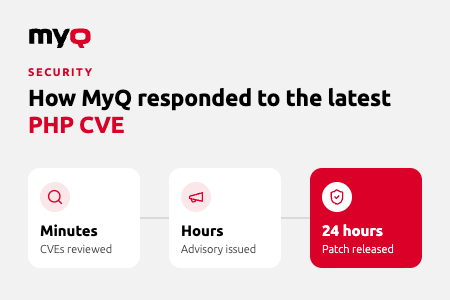
Here is the timeline, measured from the moment the PHP advisory went public.
- Within minutes: Our product development & security teams were already reviewing both CVEs against every PHP component used across MyQ solutions, working out precisely where we were exposed and where we were not.
- Within hours: we published a public advisory on the MyQ Community Portal for all MyQ partners, confirming which products and versions were affected and what partners should tell their customers. No guesswork, no waiting for a support ticket.
- Within hours: our development team had built an updated release incorporating the patched PHP runtime, ready for testing.
- 24 hours past the news: the patch passed our full QA process and was released to partners as MyQ X 10.2 Patch 29.
Which MyQ products were affected
Our analysis confirmed that MyQ X Print Server and Central Server were affected. MyQ Roger, our public cloud print management platform, was not affected.
Here is where each version stands:
- MyQ X 10.2 LTS up to Patch 28: affected. Upgrade to MyQ X 10.2 LTS Patch 29.
- MyQ X 10.3.0: includes the fixed PHP version from its first release.
- MyQ 8.2 and other end-of-life versions: affected, and no fix will be provided. Upgrade to MyQ X 10.2 LTS Patch 29.
- MyQ Roger: not affected. No action needed.
Fast, but never rushed
Speed matters in a security incident, but a patch that breaks printing in a hospital, a bank or a university is not a fix. It is a new problem.
That is why the update went through the same quality assurance process as any other MyQ release. We tested it against necessary platforms, devices and integrations before a single partner received it. The result is a release that closes the vulnerability and keeps delivering the reliability our partners and their customers expect from MyQ.
Security and quality are not a trade-off for us. Our partners should never have to choose between them.
Putting our money where our mouth is
We talk a lot about security, and about supporting our partners. This is what that looks like when it counts: a team watching threats, a clear answer for partners within hours, and a tested fix within 24 hours.
The stakes are real. Print-related data breaches are far more common than most organizations expect. A single incident can cost hundreds of thousands, and the first casualty is usually IT time.
Many organizations still assume their print infrastructure is safe because it sits behind the corporate firewall. It is not. Every printer and every print server is a network endpoint, and vulnerabilities like this one show why each needs the same care as any other critical system.
When you choose a print management platform, you are not only choosing features. You are choosing who picks up the phone, and how fast, on the day something goes wrong. Choose a vendor that puts security first and backs it with real support. That is why partners and customers choose MyQ.