



Why vendor-neutrality print management matters
28/10/2026
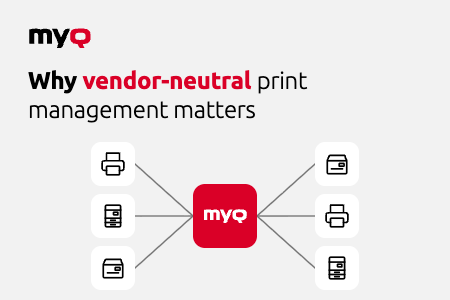
Vendor-neutral print management is a software that manages and secures printing across multiple printers and MFP brands from a single platform, rather than tying print management to one manufacturer’s devices.
This matters because mixed fleets are common in mid-sized and large organizations. Acquisitions, office moves, regional purchasing decisions, and different hardware replacement cycles can all create environments with multiple brands.
A vendor-neutral platform lets IT manage those devices consistently without replacing hardware simply because the print management platform changes.
Why mixed printer fleets are the norm, not the exception
An acquisition can bring an entirely different set of devices into the environment. An office consolidation can require existing hardware to work alongside newly purchased devices. Hardware may also be replaced gradually rather than all at once, leaving different generations and brands operating side by side.
Regional offices may make their own purchasing decisions, while different devices can be selected for different operational requirements.
The result is a mixed fleet that IT needs to manage as one environment.
A print management platform should accommodate that reality rather than forcing organizations to redesign their hardware environment around the software.
What is vendor-neutral print management?
Vendor-neutral print management means managing printers and multifunction devices from different manufacturers through a single print management platform.
Instead of the management layer being built around one manufacturer’s hardware ecosystem, the software provides common controls and workflows across the fleet. IT can manage authentication, print policies, accounting, reporting, and other print management functions without creating a separate management approach for every device brand.
This distinction becomes particularly important when hardware changes over time. A vendor-neutral platform allows organizations to replace or add devices without making their entire print management strategy dependent on the same hardware manufacturer.
The goal is straightforward: the print management platform should give IT control over the fleet; not determine which hardware the organization must buy.
Can one print management solution support multiple printer brands?
Yes. A vendor-neutral print management solution can support devices from multiple manufacturers through standardized communication methods, device integrations, and centralized management.
The important part is what happens above the individual device. Instead of managing every printer separately, IT can establish policies and workflows centrally and apply them across supported devices.
This can include:
- User authentication
- Print policies
- Secure print release
- Accounting and reporting
- Scan workflows
- Device management
- Access controls
The specific capabilities available can depend on the device and integration, but the management approach remains centralized.
For IT teams, this means adding another supported printer brand does not necessarily mean introducing another separate print management system.
What are the benefits of managing mixed printer fleets?
A vendor-neutral platform gives organizations more freedom to make hardware decisions based on business and technical requirements rather than print management compatibility alone.
That can help organizations:
- Avoid unnecessary hardware replacement: Existing devices do not automatically need to be replaced simply because an organization changes or expands its print management environment.
- Maintain negotiating flexibility: IT can evaluate hardware from different manufacturers instead of being tied to a single hardware ecosystem.
- Simplify mergers and office consolidation: Different fleets can be brought under a common management approach.
- Extend device lifecycles: Organizations can continue using suitable existing hardware alongside newer devices.
- Reduce management complexity: IT teams can manage supported devices through a centralized platform rather than maintaining separate management approaches for different manufacturers.
For organizations with distributed or changing environments, that flexibility becomes a practical IT advantage, not simply a technical feature.
What vendor-locked systems get wrong
A print management platform becomes restrictive when its capabilities are closely tied to a single manufacturer’s hardware roadmap.
That can create several problems:
- Hardware decisions become software decisions. If the platform only works with a particular hardware ecosystem, changing print management software can also mean changing devices.
- Existing hardware can become a migration problem. During an acquisition or office consolidation, two organizations may bring different fleets together. A hardware-dependent platform can make standardization more complicated.
- IT has less negotiating leverage. When the print management environment is tied to one hardware manufacturer, hardware procurement options become narrower.
- Hardware replacement can become unnecessarily expensive. Organizations may face additional capital expenditure simply to maintain compatibility with their print management environment.
- Migrations become more disruptive. Changing the management platform can require changes across devices, deployment processes, and user workflows at the same time.
Vendor neutrality does not eliminate the complexity of managing a physical fleet. It prevents the print management layer from adding unnecessary hardware restrictions to that complexity.
How MyQ makes it easier and reliable
MyQ is designed to manage print environments across multiple printers and MFP manufacturers from a centralized platform.
With MyQ, organizations can use a common management approach across supported devices rather than building their print environment around one hardware manufacturer.
This includes capabilities such as:
- Multi-vendor support: Manage supported devices from different manufacturers within the same MyQ environment.
- Centralized management: Apply print management policies and manage the environment from a central platform.
- Secure printing: Provide consistent, secure print workflows across supported devices.
- Accounting and reporting: Maintain visibility into print activity across the managed environment.
- Embedded terminal support: Use MyQ functionality across supported devices from different manufacturers.
The practical benefit is choice. Organizations can evolve their hardware fleet without making their print management strategy dependent on a single manufacturer.
Vendor neutrality is a long-term IT decision
Choosing a print management platform is not only about what the organization needs from its printer fleet today.
Hardware changes. Offices move. Companies acquire other organizations. Devices reach the end of their lifecycle. Procurement requirements change.
A platform that supports multiple printer brands gives IT more room to respond to those changes without rebuilding its print management environment every time the hardware landscape changes.
Vendor-neutral print management therefore comes down to a simple principle: your print management platform should work with your hardware strategy, rather than dictating it.
For years, many organizations could treat printing as a relatively stable part of their IT environment.
News & Updates
3 min read
MyQ, a leading provider of print and document management solutions, today announced that MyQ X 10.2 is now available on Brother multifunction devices, further strengthening its position as a truly multivendor platform.
News & Updates
3 min read
For many organizations, print infrastructure has traditionally been treated as a background IT function - necessary, but rarely strategic.
News & Updates
2 min read